

Finite Groups and
Their Representations
FGTR 2025 · Mathematics Research Center, ASOIU
June 18–20, 2025 · Baku, Azerbaijan
This three-day workshop brings together researchers working in the theory of finite groups and their representations, with a particular focus on fusion systems, block theory, biset functors, and character-theoretic methods.
The programme features seven invited talks by leading specialists from Turkey, the United States, and Azerbaijan, covering topics ranging from the Alperin–McKay conjecture and Feit’s conjecture to categorical decompositions of biset functors and weight conjectures for exotic fusion systems.
The workshop is organized by the Mathematics Research Center of ASOIU (Azerbaijan State Oil and Industry University), Baku.
Click a card to view biography
Click a title to expand the abstract
The pointed fusion system of a block is a category and a poset that refines the fusion system. Like the fusion system, it is a local invariant in that it is determined by the source algebra. Unlike the fusion system, it determines the number of simple modules. We shall show that it satisfies a generalization of the saturation condition. If it could be argued that mysterious invariants might be needed to cut inroads to the outstanding conjectures of block theory, then the pointed fusion system fits the bill: we do not know whether it coincides with what Thévenaz called the Puig category.
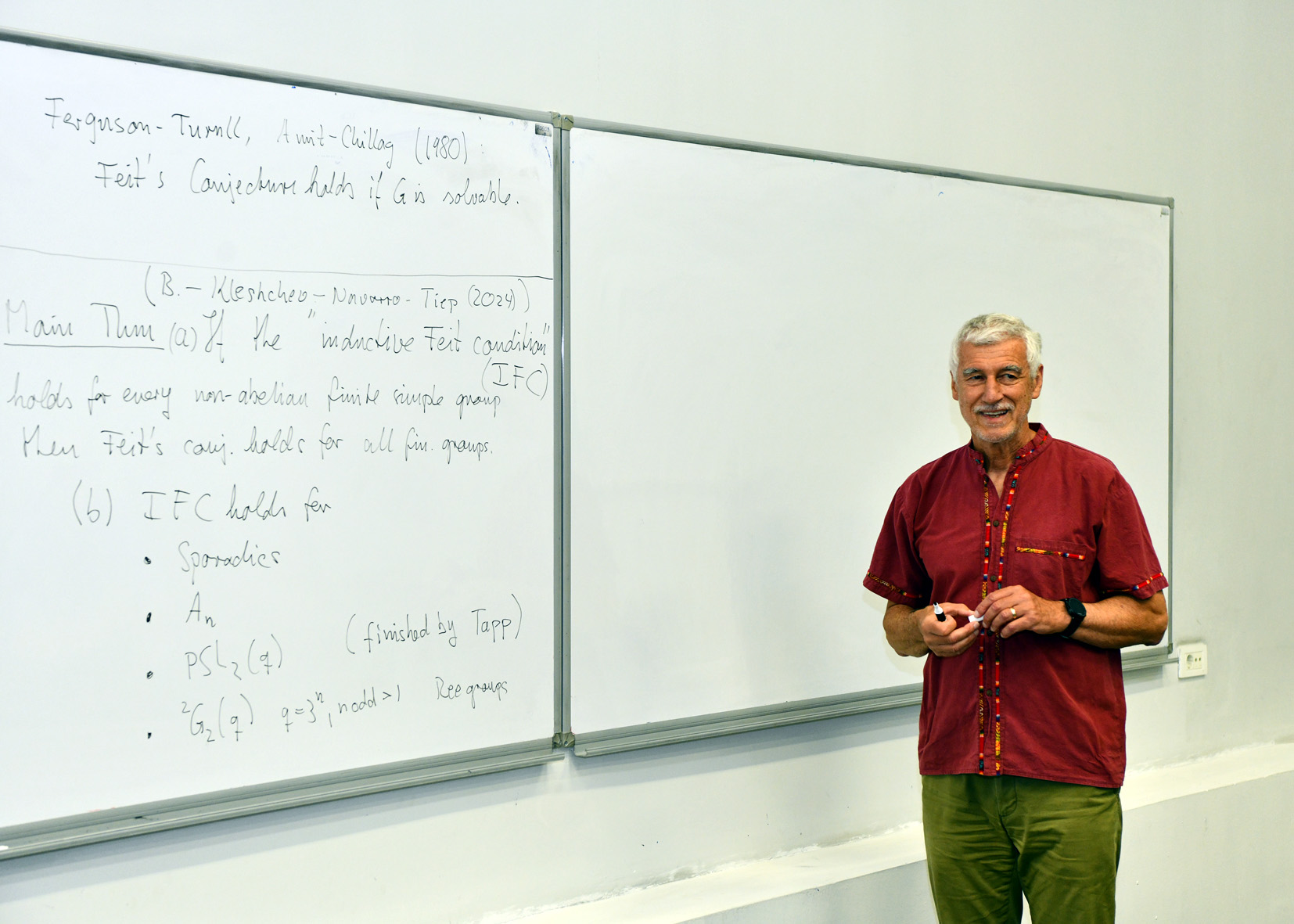
In 1979, Walter Feit suggested to use the classification of finite simple groups to decide if the following statement holds: If \(\chi\) is an irreducible character of a finite group \(G\) and if \(n\) is the smallest positive integer such that all values of \(\chi\) belong to the \(n\)-th cyclotomic field then \(G\) has an element of order \(n\). In 1986, Ferguson–Turull and Amit–Chillag proved independently that this holds if \(G\) is solvable. Not much progress has been made in the following years. Only recently, in joint work with A. Kleshchev, G. Navarro, and Ph. H. Tiep, we showed that the answer is yes, provided that every non-abelian finite simple group satisfies a condition that we call the inductive Feit condition. This talk describes the reduction theorem and other related results and conjectures.
In this talk, we aim to present a generalization of the Alperin–Goldschmidt fusion theorem for saturated fusion systems. Our approach introduces the notion of \(\mathcal{F}\)-essential subgroups relative to a strongly \(\mathcal{F}\)-closed subgroup \(P\) of a \(p\)-group \(S\). We show that any \(\mathcal{F}\)-isomorphism between subgroups of \(P\) can be decomposed using some automorphisms of \(P\) and these relative \(\mathcal{F}\)-essential subgroups. When \(P\) is taken to be equal to \(S\), the Alperin–Goldschmidt fusion theorem can be obtained as a special case.
A \(p\)-group \(P\) is strongly resistant in saturated fusion systems if \(P \unlhd \mathcal{F}\) whenever there is an over \(p\)-group \(S\) and a saturated fusion system \(\mathcal{F}\) on \(S\) such that \(P\) is strongly \(\mathcal{F}\)-closed. We show that several classes of \(p\)-groups are strongly resistant. We also give a new necessary and sufficient criterion for a strongly \(\mathcal{F}\)-closed subgroup to be normal in \(\mathcal{F}\). These results are obtained as a consequence of developing a theory of quasi and semi-saturated fusion systems, which seems to be interesting in its own right.
We will introduce the notion of a link between character triples. The motivation to consider this notion has multiple reasons. Firstly, links between character triples induce special character triple isomorphisms. This provides a new perspective for isomorphisms between character triples and a different conceptual understanding. Secondly, links between character triples provide equivalent reformulations of complicated conditions (involving projective representations) that play a fundamental role in the reductions of the McKay conjecture and the Feit conjecture to finite simple groups. This is joint work with Robert Boltje and John Revere McHugh.
We generalize Bouc’s construction of orthogonal idempotents in the double Burnside algebra to the setting of the double \(\mathbb{C}^\times\)-fibered Burnside algebra. This yields a structural decomposition of the evaluations of \(\mathbb{C}^\times\)-fibered biset functors on finite groups. We then construct a complete set of orthogonal idempotents in the category of \(\mathbb{C}^\times\)-fibered \(p\)-biset functors, leading to a categorical decomposition of this category into subcategories indexed by isomorphism classes of atoric \(p\)-groups. Furthermore, we introduce the notion of vertices for indecomposable functors and establish that the \(\mathrm{Ext}\)-groups between simple functors with distinct vertices vanish. As an application, we describe a set containing composition factors of the monomial Burnside functor, thereby providing new insights into its structure. Additionally, we develop a technique for analyzing fibered biset functors via their underlying biset structures. This is a joint work with Olcay Coşkun.
Weight conjectures for fusion systems are conjectural statements for fusion systems which are motivated by local-global conjectures in block theory and were put forward by Kessar, Linckelmann, Lynd and Semeraro in 2019. In fact, the interest in weight conjectures goes beyond the local-global conjectures from block theory. They apply equally well in the situation where the fusion system is block-exotic. In the first part of the talk, I will introduce these conjectures and mention their link to conjectures in block theory. Then I will present the results which verify these conjectures for the family of Parker–Semeraro fusion systems which contains 27 block-exotic fusion systems. This is a joint work with Kessar, Semeraro and Serwene.
Let \(p\) be a prime number and let \(\mathbb{F}\) be an algebraically closed field of characteristic \(0\) or \(p\). In this talk we introduce the notion of diagonal \(p\)-permutation functors over \(\mathbb{F}\). We show that the simple diagonal \(p\)-permutation functors \(S_{L,u,V}\) are parametrized by triples \((L,u,V)\) where \(L\) is a \(p\)-group, \(u\) is a \(p’\)-automorphism of \(L\) and \(V\) is a simple \(\mathbb{F}\mathrm{Out}(L,u)\)-module. We also describe the evaluations of the simple functors. In particular, if \(\mathbb{F}\) has characteristic \(p\), we show that for a finite group \(G\), the dimension of \(S_{L,1,\mathbb{F}}(G)\) is equal to the number of conjugacy classes of \(p\)-regular elements of \(G\) with defect isomorphic to \(L\). We finally prove that if \(\mathbb{F}\) is of characteristic zero, then the category of diagonal \(p\)-permutation functors is semisimple. This is a joint work with Bouc.
We will talk about the notion of functorial equivalences between blocks of finite groups, a notion introduced using the theory of diagonal \(p\)-permutation functors. We investigate the invariants preserved by functorial equivalences and their relations with other well-studied equivalences. We prove a finiteness theorem in the spirit of Donovan’s and Puig’s finiteness conjectures: there are only finitely many blocks of finite groups with a given defect group, up to functorial equivalence. We also give a reformulation of Alperin’s weight conjecture in terms of diagonal \(p\)-permutation functors. Some parts of this work are joint with Boltje and Bouc.
Talks are 50 minutes · 10-minute breaks between sessions
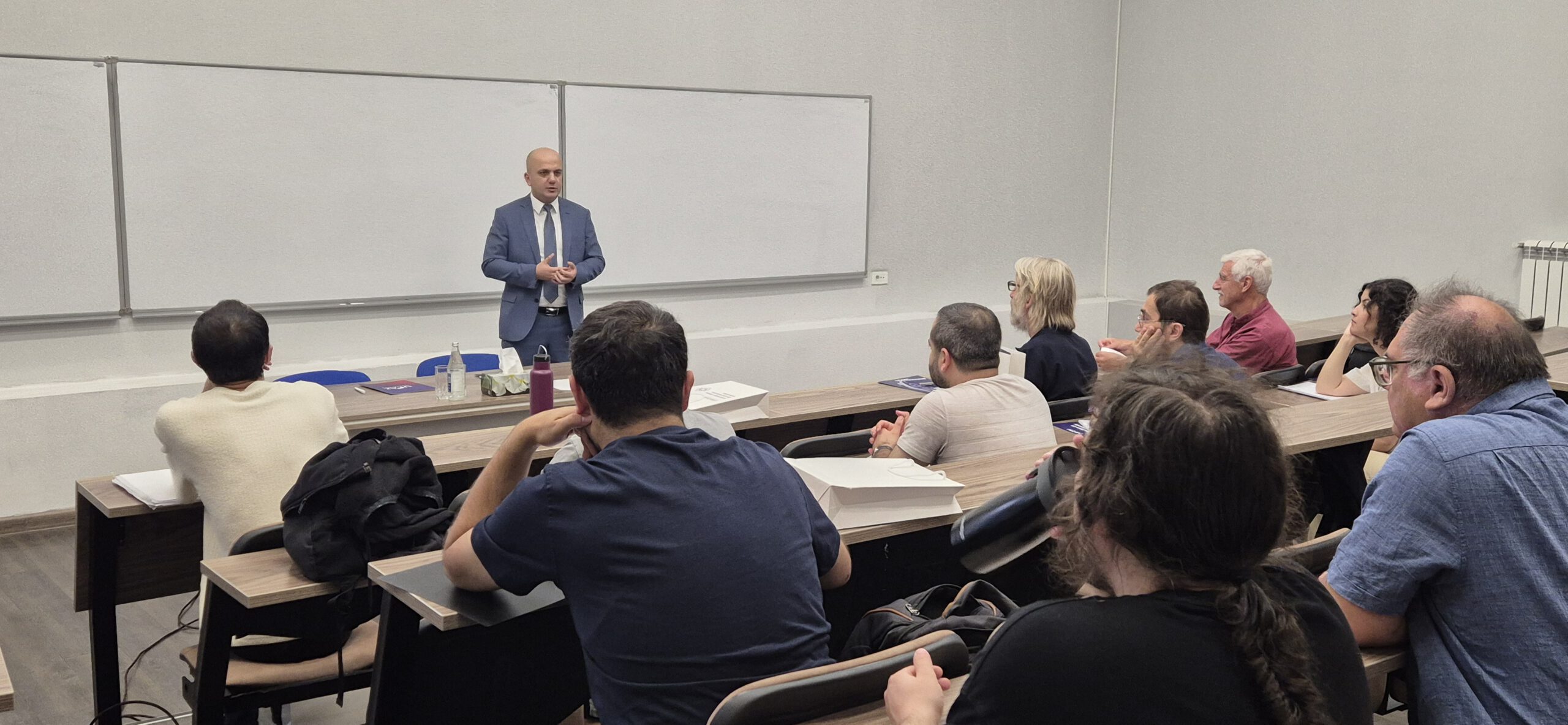
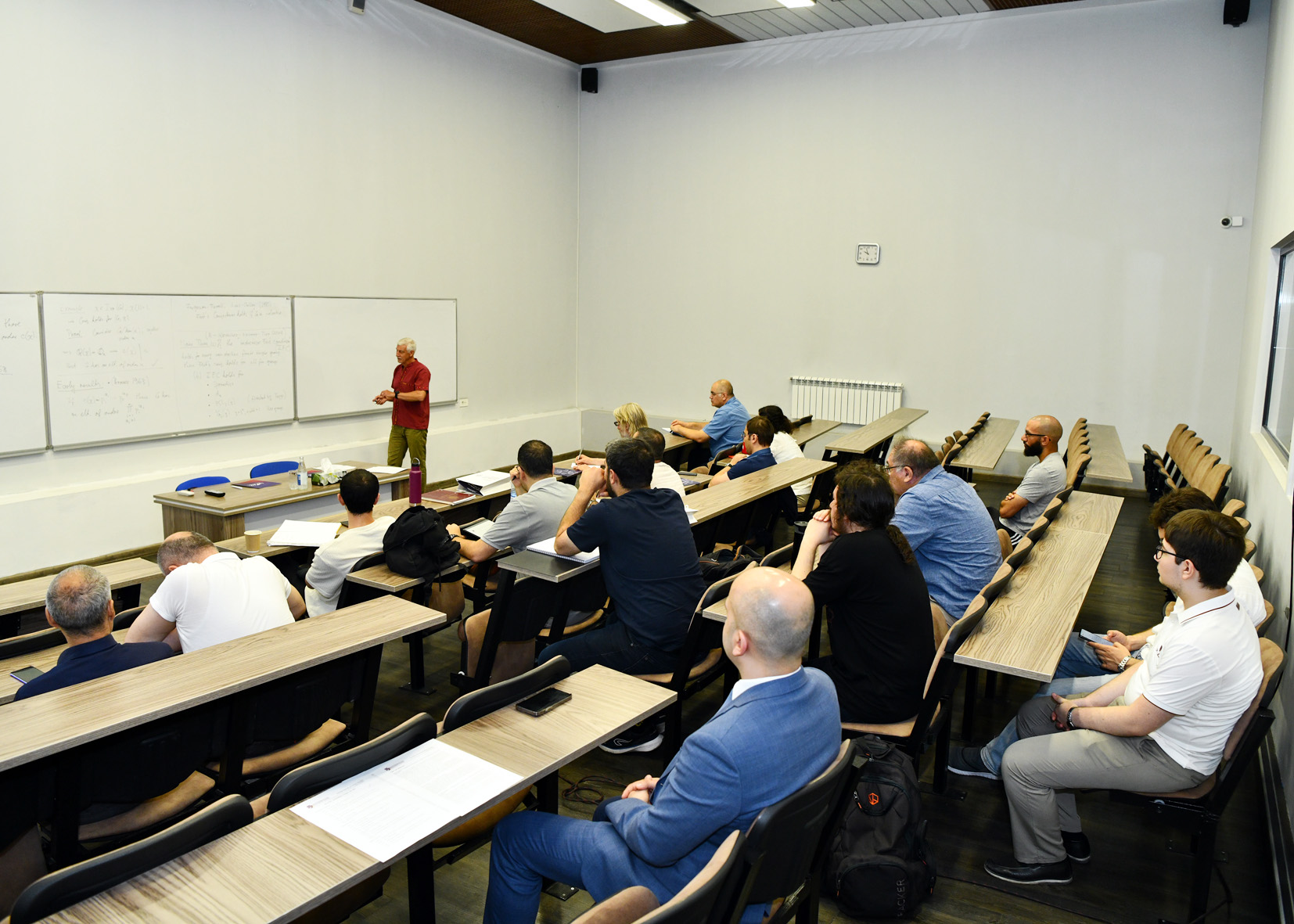
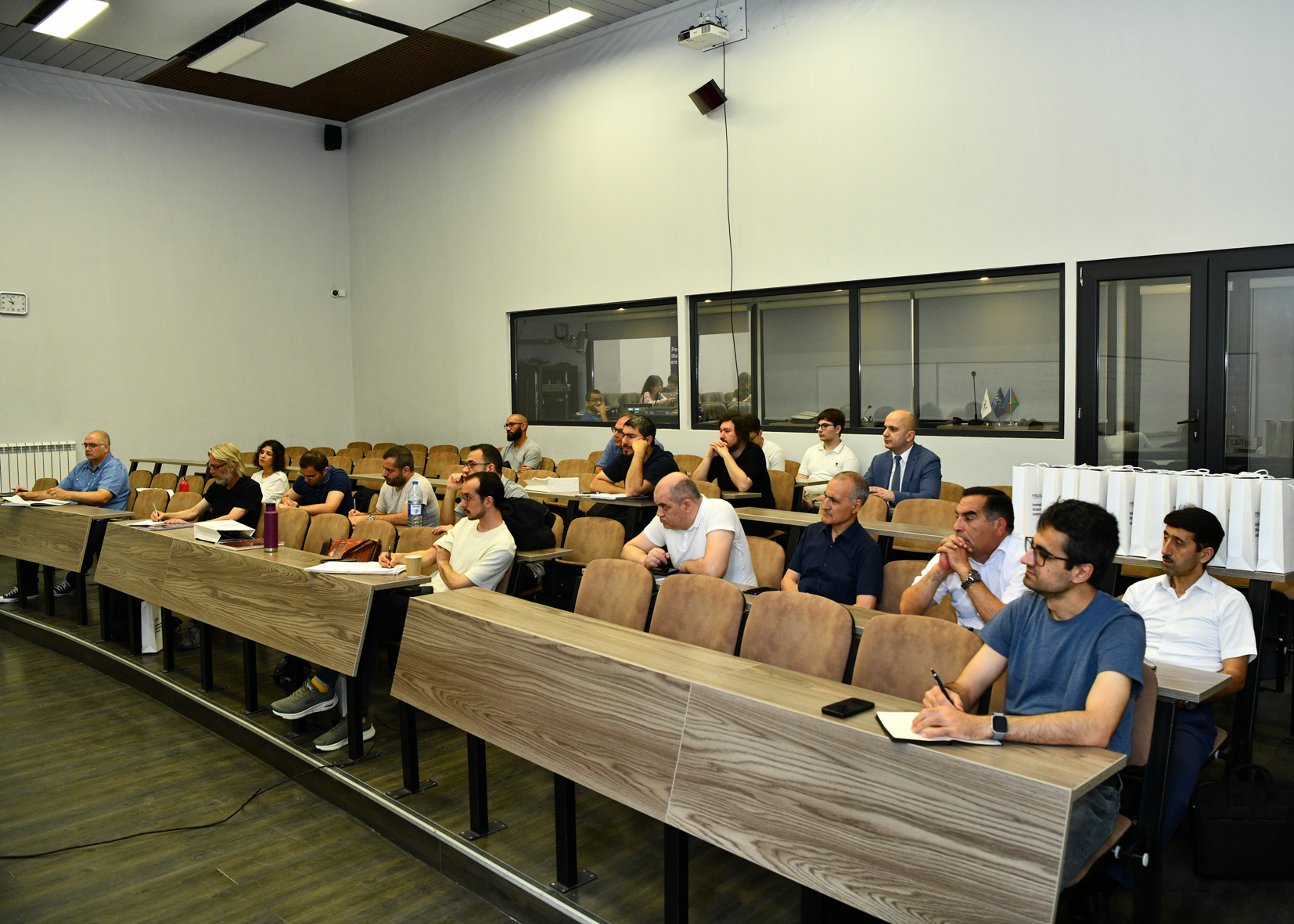
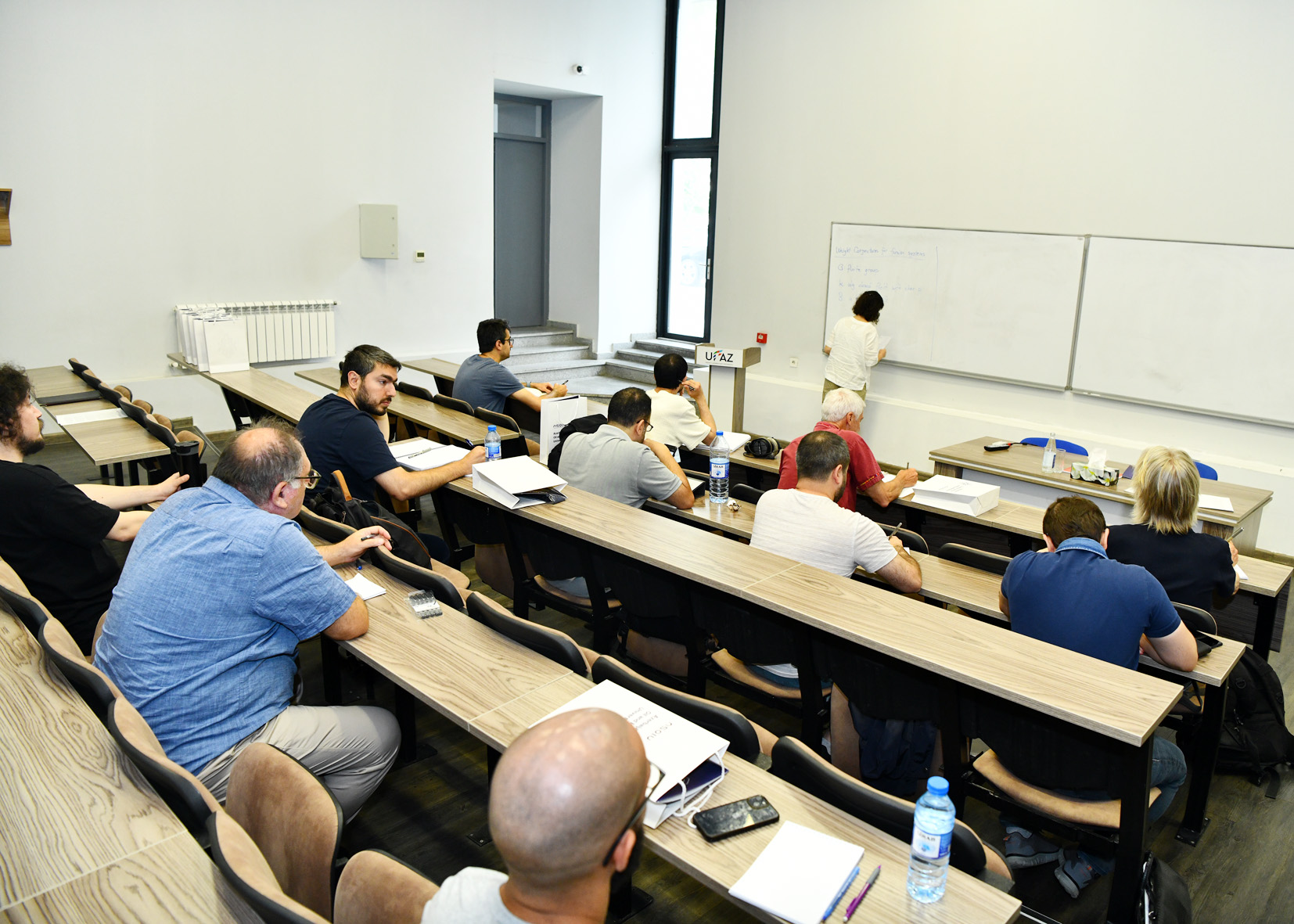
Venue, organisation, and contact details
Venue
The workshop takes place at the Mathematics Research Center of ASOIU (Azerbaijan State Oil and Industry University), Baku, Azerbaijan.
Getting to Baku
- International flights to Heydar Aliyev International Airport (GYD)
- Well connected from Istanbul, Moscow, Dubai, and major European hubs
- City centre easily reached by taxi or metro from the airport
About Baku
Baku is the capital of Azerbaijan, situated on the Caspian Sea. The city blends a UNESCO-listed medieval Old City with modern architecture, and hosts a vibrant mathematical community through institutions such as ASOIU and ADA University.
Organizer
Participants
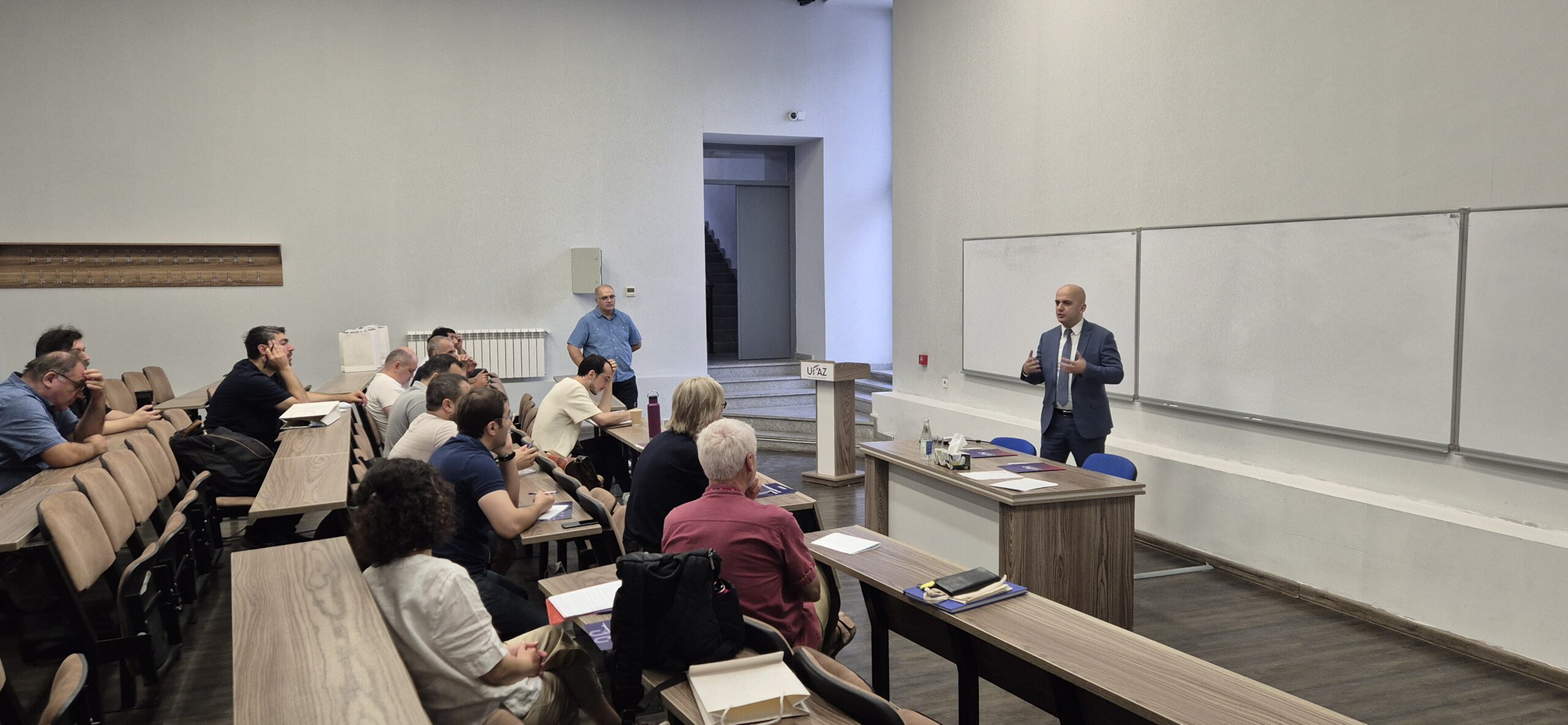
The workshop features 7 invited talks by specialists from Bilkent University, UC Santa Cruz, ADA University, and Mimar Sinan Fine Arts University, covering fusion systems, block theory, biset functors, and character theory.
Contact
For enquiries about the workshop, please contact the Mathematics Research Center at ASOIU, Baku.